




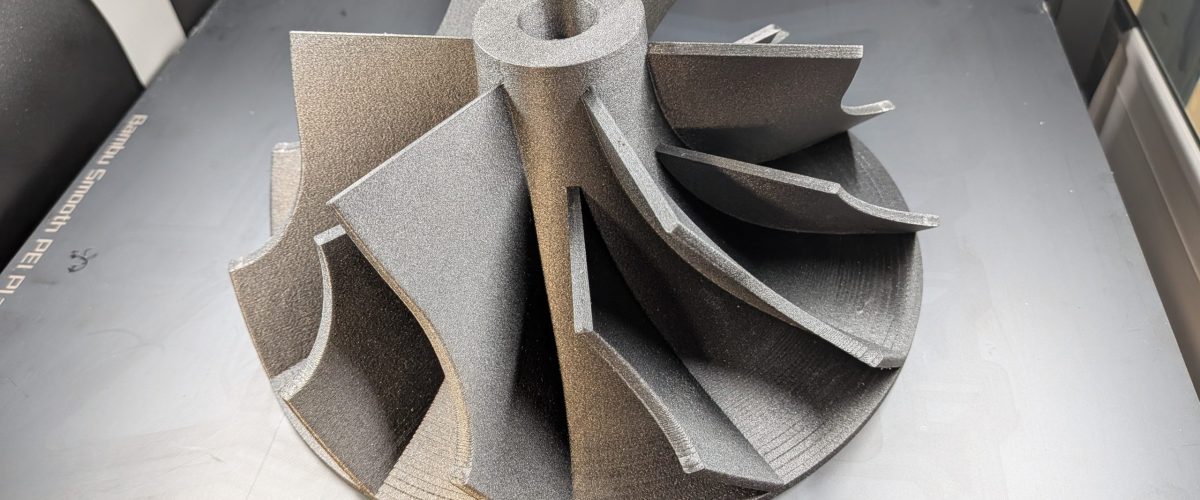
PPA-CF
PPA-CF is a high-performance 3D printing filament made from polyphthalamide, or PPA, a high-temperature nylon reinforced with short carbon fibers. The material is known for its excellent mechanical and thermal properties.
Properties
The addition of carbon fiber significantly increases the tensile strength of the filament, making it one of the strongest 3D printing materials available. PPA-CF parts are extremely rigid, which makes them ideal for structural components that need to withstand bending or deformation under load.
Thanks to the controlled dispersion method of 15 wt% carbon fiber, PPA-CF offers lower density, low moisture absorption, high strength and stiffness, excellent wear and creep resistance, as well as outstanding chemical and heat resistance.
PPA has significantly lower moisture absorption compared with other nylon-based filaments. This is an important advantage, as it helps the material retain its mechanical properties and dimensional stability even in humid conditions.
PPA is not a new invention — but it is not a basic plastic either
PPA, or polyphthalamide, is not a hyped material from recent years. Its roots go back to the 1980s and 1990s, when the chemical industry began developing versions of polyamides that could better withstand heat, chemicals and mechanical stress than traditional polyamide.
Behind this was a typical engineering problem: the automotive industry needed a plastic that could survive under the hood — an environment where temperatures range from below freezing to very high levels, and where parts may come into contact with substances such as oil and glycol. Traditional PA was not durable enough, while metal was expensive, heavy and often unnecessary.
PPA was developed as the solution.
Not because someone wanted a “better plastic”, but because a material was needed that would not fail during the first service cycle.
How does PPA differ in practice from traditional polyamide?
PPA is still a polyamide, but its structure and properties differ from widely used plastics such as PA6 and PA12.
The main difference lies in the polymer chain: PPA contains more aromatic structures, which make the chain stiffer and more heat resistant.
In practice, PPA differs from traditional polyamides in the following ways:
- higher heat resistance
- stiffness is retained as temperature increases
- lower moisture absorption
In other words, there is less of the classic PA phenomenon where the material is one thing when new and dry, and something else after a week in use.
Why is PPA not used more widely?
This is perhaps the most interesting thing about PPA. PPA solves many problems, but it has usually not been the “default material”. The reason is most often habit, and sometimes a lack of information or challenges with availability.
Polyamides, or PA materials, have been a standard choice for industrial needs for decades. They are inexpensive, familiar and “good enough” for most applications. When they are not enough, the next step is often directly to something heavier-duty — such as PPS or even metal.
PPA sits between these options, and it may be left out of consideration when moving directly from PA plastics to more robust materials.
PPA is usually not the cheapest option, but it is also not “exotic” enough to be automatically included in material comparisons. In practice, many people only come across PPA when something goes wrong and alternative materials are evaluated more carefully.
PPA as part of Materflow’s material range
For us, PPA entered the discussion when we were reviewing alternatives between PA and PPS. It was not originally our first choice as an addition to the material range.
However PPA-CF in practice is at the cost level of PA6 or PA12 for our customers
We decided to add PPA to our range because:
- its performance is clearly better than PA
- it is significantly easier to use than PPS
- the price is in the same range
A practical alternative to glass-filled SLS PA materials
In many cases, PPA-CF can make glass- or fiber-filled SLS PA materials unnecessary. The main advantage of SLS remains its greater design freedom, especially for geometries that are difficult to produce with FDM.
However, using engineering-grade FDM materials such as PPA-CF can make production more flexible, reduce costs and, in suitable cases, lower the carbon footprint of the overall production process.
If non-reinforced SLS PA12 is not stiff enough for your application, PPA-CF is worth considering as an alternative to materials such as PA3200GF or PA12GF.
Applications
PPA is not a material that beats every competitor in one individual specification, but it offers clear advantages in changing conditions:
- heat does not alter the structure
- dimensional accuracy is maintained better than with PA6 or PA12 plastics
- stiffness is retained during use
- moisture does not change the shape or properties of the part
PPA is an especially good choice for applications that require metal-like strength, heat resistance, low weight and chemical resistance. When PA6 or PA12 is no longer enough, PPA can be an excellent solution. Examples of such applications can be found in:
- the aerospace industry
- the automotive industry
- the electronics and electrical industry
PPA is suitable for functional parts, brackets, fixtures and structural parts. Its low weight and strength make it a good choice for aerospace applications, while its dimensional stability enables its use in housings and fixtures.
Mechanical Properties
3D Printing technology:: FDM
Build chamber/max size: 300mm x 300 mm x 300 mm
Layer thickness: 200 um
Dimensional accuracy: ± 0,2mm + ± 0,1mm/100mm
Depending on part geometry the accuracy can vary and most of the time +-0.2 accuracy can be achieved
