




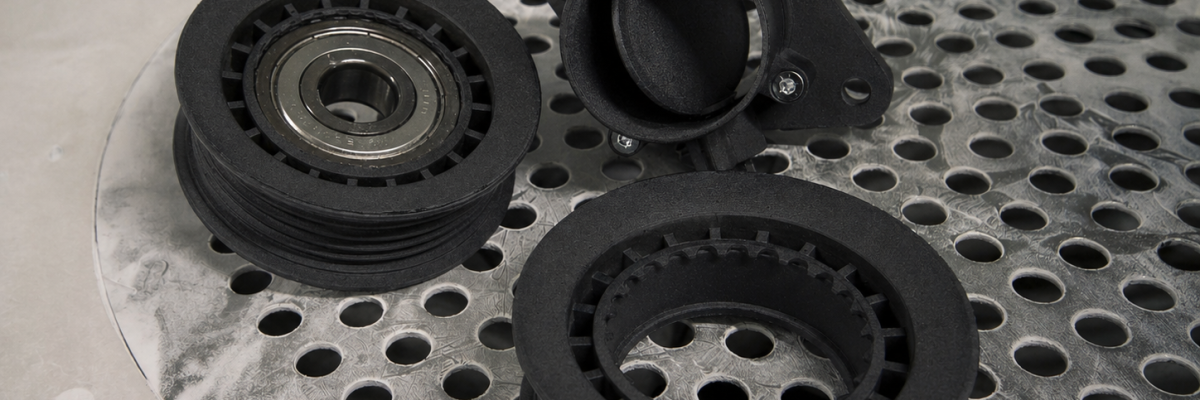
PBT-CF
PBT, or polybutylene terephthalate, is an engineering thermoplastic that has long been used in injection-moulded industrial components. It is typically used in applications that require good dimensional stability, stiffness, heat resistance, and chemical resistance. PBT is commonly found in electrical and electronics components, housings, connectors, brackets, and machine parts.
In 3D printing, PBT has traditionally been less common than PA12 polyamide, which has been the most widely used SLS material. PBT-CF brings the technical properties of PBT to powder bed fusion and combines them with the stiffness provided by carbon fibre reinforcement. The result is a material well suited for functional parts, production aids, and technical end-use components.
At Materflow, PBT-CF has effectively replaced the previously used glass bead reinforced PA3200GF material. In PA3200GF, the reinforcement consists of round glass beads, whereas PBT-CF is reinforced with carbon fibre. One challenge with glass bead reinforcement is that the beads may have weaker adhesion to the polymer matrix, which can cause the material to fail or fracture more easily in some demanding applications. Fibre reinforcement behaves differently within the structure, and the fibres do not detach from the material in the same way as round glass beads.
The clearest advantage of PBT-CF is its high stiffness and fibre-reinforced structure. It is well suited for applications where glass bead reinforced PA3200GF has previously been used, but where a stiffer, more dimensionally stable, and technically more capable alternative is required.
3D Printing Technique: Selective Laser Sintering (SLS)
Build chamber/max size: 350 mm x 350 mm x 500 mm
Layer thickness: 100 um
Dimensional accuracy: ± 0,25mm + ± 0,1mm/100mm
Read more:
> About Selective Laser Sintering
> Design Guidelines for Selective Laser Sintering
Mechanical properties